
What I was Reading When I was in Hospital…
THIS BLOG has been pretty patchy over the last few months. This is why.
In November I went on a week long holiday to the island of Malta with two very good friends. On the second day I was rushed to hospital with sepsis and I was there for three weeks. You don’t need the details, but I do want to say how grateful I am to the medical team at Mater Dei General hospital and to my parents who had the great good sense to be born in Ireland which means I have dual nationality and could wave an EU passport.
I am feeling so much better and have a lot of good intentions about writing more: more stories, more books, more lesson plans and yes, more blog posts. Let’s see how I do. I am well aware of where good intentions can lead, but being ill is a heavy-handed reminder we should do what we can, when we can. So, here goes.
The Books I Took with Me
I presumed I wouldn’t have a lot of time for reading. I envisaged long evenings talking and laughing with friends over good food and wine and one thing I discovered in those first days is that Malta produces great red wine which I don’t think they export widely. (Production levels aren’t high and they like to drink it too.)

I picked up The Secret of Life of Walter Mitty in a charity shop, attracted by its slim size (don’t judge, I was going to carry it) and the fact that I knew next to nothing about an iconic character whose name I’ve known all my life. It was a big shock to discover that The Secret Life isn’t a novel but a short, short story, first published in the New Yorker in March 1939. You probably knew that: I didn’t.
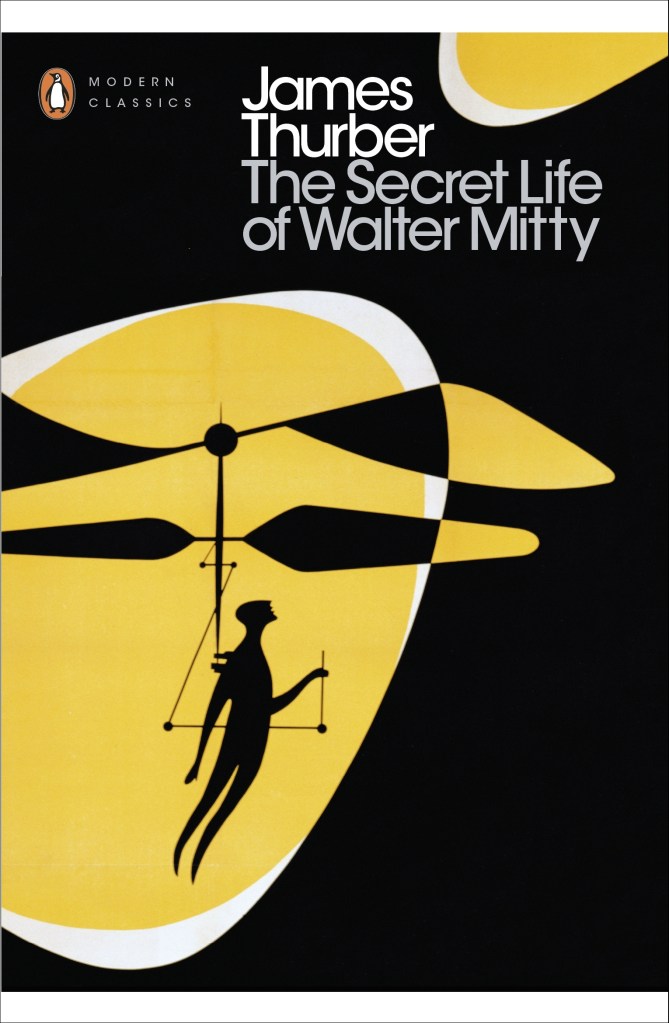
In his head, Walter is the hero of his own life, allowing pretty outlandish fantasies get him through another humdrum day. In most reviews, it’s described as an escape from a domineering wife which is harsh. Imagine living with someone as ineffectual and passive as Walter, imagine how skin-itching irritating it would be. I suspect the wife only dominates because there is a husband-shaped void in the relationship.
However, for me, the most important element of the story is the gentle humour and humanity of the writing. Walter is part of us. He’s not the best part perhaps, but ridiculous dreams – the ones where we leap over barricades to nurse the wounded or command armies against terrible odds – lighten the load. If you’re in an actual revolution or war situation I imagine you fantasise about soft tea-drinking days and the sweet predictability of the ordinary. James Thurber apparently based the character loosely on himself which makes me like it even more.
I also took Adam Kay’s bestselling This is Going to Hurt without realising how appropriate it was going to be. Having watched the TV series, I expected biting aphorisms about the NHS and black humour drawn from real life experiences as a doctor. I got them. I loved his description of a consultant’s reaction to a patient’s unquestioning belief in the kindness of Mother Nature.
Apricot stones contain cyanide,’ he replies drily. ‘The death cap mushroom has a fifty per cent fatality rate. Natural does not equal safe. There’s a plant in my garden where if you simply sat under it for ten minutes then you’d be dead.’ Job done: she bins the tablets. I ask him about that plant over a colonoscopy later. ‘Water lily.‘
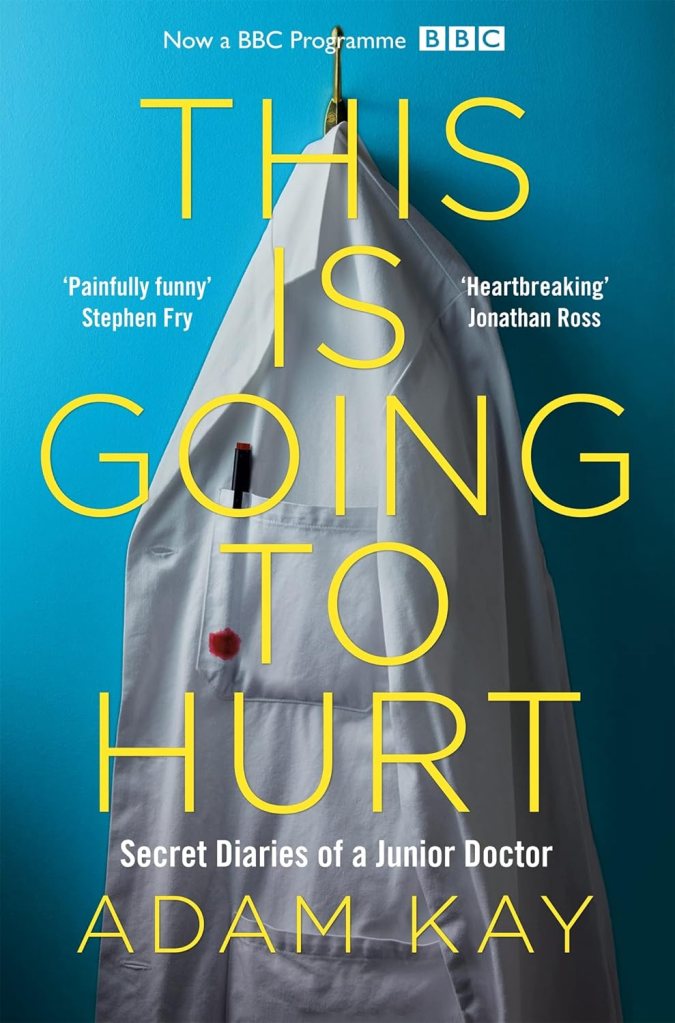
Perhaps reading about the inadequacies of an under funded health services and the sheer terror of an inexperienced medic thrown into the blood, guts and heartache of an A&E department wasn’t ideal, but I think it helped me to see outside my small, bed-sized world. It certanly made me laugh. I hoped it also made me less able to take the staff for granted. When my consultant saw the book on my bedside locker, she smiled and tapped the cover. “It’s all true, you know.”
The other side to Kay’s lightening wit is his honesty and humanity.
You don’t cure depression, the same way you don’t cure asthma; you manage it. I’m the inhaler he’s decided to go with and I should be pleased he’s gone this long without an attack.
The Book I was Given
These two books couldn’t possibly satisfy my needs after I came out of intensive care. I swallowed then whole in a couple of days. After all, I had nothing to do except sleep, eat, get better and read. Magazines couldn’t cut it. I needed a proper read, but something I could dip into rather than a twisty mystery that demanded levels of concentration I did not possess. I was given Humankind: A Hopeful History by Rutger Bregman.
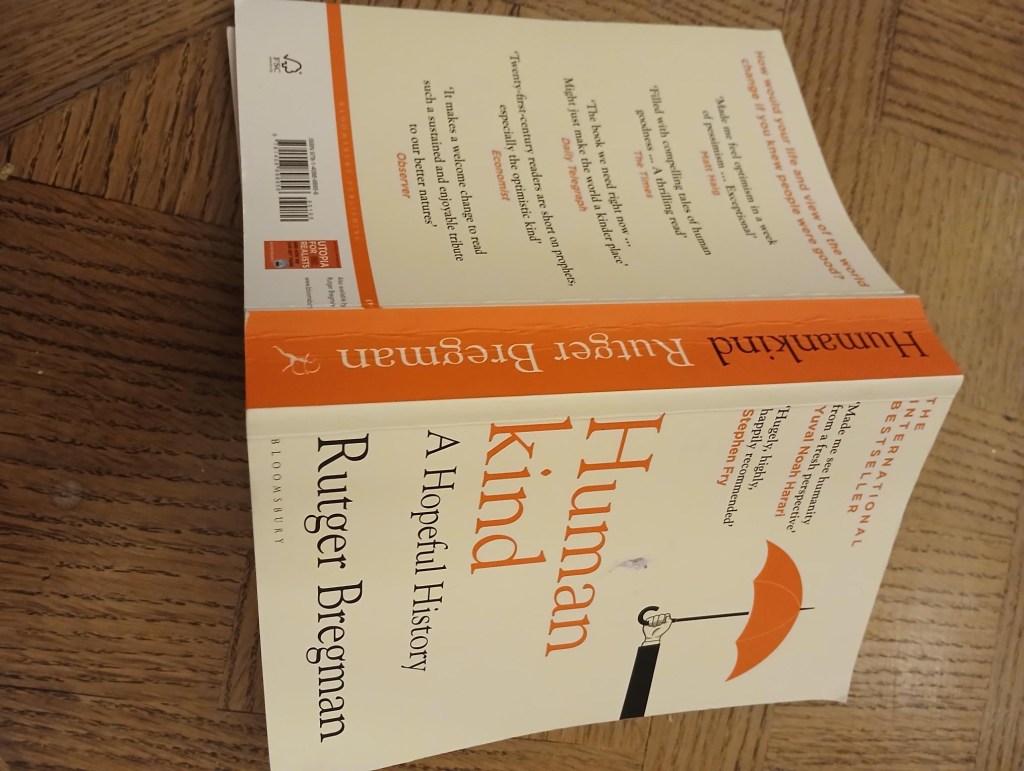
His premise is that basically people are ok and that living in the 21st century means we have already won the lottery of life because it is so much better than it was in the past. Some of his ideas rang true, especially as I already knew that I was incredibly fortunate to be where I was, getting the treatment I needed.
However, he also forced me to question stuff I was equally certain about – such as the importance of empathy – which was as uncomfortable as the five-times-a-day blood pressure readings or contemplating the boiled fish lunch which looked exactly the same as the boiled chicken served the day before.
…empathy makes us less forgiving, because the more we identify with victims, the more we generalise about our enemies. The bright spotlight we shine on our chosen few makes us blind to the perspective of our adversaries, because everybody else falls outside our view…
Empathy means finding a connection with other people and their experiences, which is great, but what about people we can’t connect with?
As humans…we play favourites and care more about our own. That’s nothing to be ashamed of – it makes us human. But we must also understand that those others, those distant strangers, also have families they love. That they are every bit as human as we are.
I gave the book back to the friend who lent it to me and bought my own copy when I got home, because yes, people are basically ok. I met a lot of very ok people in Malta, sadly over a temperature chart rather than a glass of the island’s fine wine, but you take what you can.
Andrew Kay’s book reveals most of humanity’s ok-ness too in a different way. And that’s true, even if we aren’t perfect and sometimes need to get outside ourselves and the real world, like Walter Mitty.
8 comments on “What I was Reading When I was in Hospital…”
Leave a comment
Over 125 reviews & 280 ratings on Amazon
A Good Confession

"Unputdownable" Miriam Stoppard


 BRIDGET WHELAN writer
wow, good to know you are okay and had no idea all you were going through. this could be a book in itself. what a mix of books you read and when you are bed-ridden you are a captive audience so books or media are really your only choice of ways to spend your time. take good care and good to see you here.
LikeLike
Thank you, Beth. That’s so kind. Those books meant a lot to me back then, and still do.
LikeLiked by 1 person
You have truly endured an ordeal, Bridget. All your students and fans wish you a complete recovery. Funny that you would mention about picking up a copy of THE SECRET LIFE OF WALTER MITTY in a thrift shop. I volunteer at one such shop (the charity is SAVE THE CHILDREN) on Saturday mornings. Apart from the clothing, old china and glassware and antique furniture, it truly is also a book lovers paradise. I love being around those aisles once a week!
In dedication to Walter Mitty – a trailer for the original 1947 version starring Danny Kaye –
The Secret Life of Walter Mitty (1947) Trailer
and the 2013 version, starring and directed by Ben Stiller –
The Secret Life Of Walter Mitty 2013 Official trailer
LikeLike
You have truly endured an ordeal, Bridget. All your students and fans wish you a complete recovery. Funny that you would mention about picking up a copy of THE SECRET LIFE OF WALTER MITTY in a thrift shop. I volunteer at one such shop (the charity is SAVE THE CHILDREN) on Saturday mornings. Apart from the clothing, old china and glassware and antique furniture, it truly is also a book lovers paradise. I love being around those aisles once a week!
In dedication to Walter Mitty – a trailer for the original 1947 version starring Danny Kaye –
The Secret Life of Walter Mitty (1947) Trailer
and the 2013 version, starring and directed by Ben Stiller –
The Secret Life Of Walter Mitty 2013 Official trailer
LikeLike
Thank you Glen and thank you for the two clips of the Walter Mitty films, enjoyed them both but Danny Kaye is just so Mitty-esque.
LikeLike
My goodness, you went through so much. Books are just what you needed, and thank you for sharing them. Take care!
LikeLike
Thank you, Jennie.
LikeLiked by 1 person
You’re welcome.
LikeLike