
Who needs quotation marks?
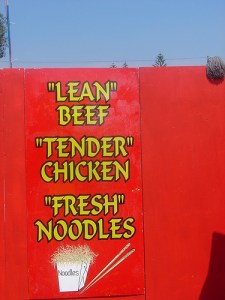 Well, the writer of this sign didn’t need them and Cormac McCarthy, author of the The Road and No Country for Old Men, never uses them. He believes in the absolute minimum punctuation. He uses full stops and capital letters, commas when they are essential, colons rarely and never ever semi colons or quotation marks. If you write properly you shouldn’t have to punctuate, he says and part of writing properly is to guide readers as to who’s speaking.
Here’s a short extract from The Road to show how he does it.
The boy turned in the blankets. Then he opened his eyes. Hi, Papa, he said.
I’m right here.
I know.
An hour later they were on the road. He pushed the cart and both he and the boy carried knapsacks. In the knapsacks were essential things.
It works. I like McCarthy’s writing and find his style of short sentences grimly compelling. His approach to punctuation fits with the stark simplicity of his prose. But I also like writers like Flann O’Brien and Charles Dickens and John Irving and…Alice Munro…and…
One size does not fit all and I can’t see myself abandoning quotation marks altogether. However, I have taken a strong dislike to the double quote “like this” and much prefer the elegance of ‘single quotes’. In America publishing houses though I gather that’s considered bordering on the illiterate.
For more on McCarthy’s feelings on the weird little marks that can mess up a page visit Open Culture or view his 2008 interview with Oprah Winfrey
What about you – single quotes, double or none at all?
photo credit: Kat. via photopin cc
13 comments on “Who needs quotation marks?”
Leave a comment
Over 125 reviews & 280 ratings on Amazon
A Good Confession

"Unputdownable" Miriam Stoppard


 BRIDGET WHELAN writer
Louis Begley too. Lean and clear. Wonderful.
LikeLike
Never read him. Will now – which book do you suggest for a Begley-beginner?
LikeLike
Hmmm, very interesting. My latest blog post was full of them, probably highly unnecessary, so I shall take note for future reference.
Would italics be a good way of emphasising a point or should it just be obvious from the writing skill (which I have yet master!)?
LikeLike
Italics might work but wouldn’t it look odd on the page if there were large blocksof italics…? I like single quotes and I’m going to stick with them – they are a useful tool – but there is something wonderful in the way writers like McCarthy can pare everything back to the bone.
LikeLike
Single quotes nearly always, double quotes only for a quote within a quote, but then I’m British and that’s the way we do it.
LikeLike
You think single quotes is the British style? I wasn’t sure – certainly it’s the way I prefer
LikeLike
Very interesting! I do like my quotation marks when people are talking, but I really dislike using them for other things – like that “double quote” thing you mentioned. Single quotes or italics when it’s a random word in the middle of a sentence! Although the problem I’ve run into is that I also like to use italics for characters’ thoughts, so I don’t want to confuse people by using too much italicization. I think the conclusion here is that punctuation is confusing 😀
LikeLike
Italics are a good standby for all sorts of things – seems silly to throw them away on dialogue when we have other ways of showing that it is speech.
LikeLike
I prefer single quotes. Easier to type as you don’t need to press the shift key.
Some of the women’s mags prefer double quotes though, and changing a story from single to double is a right pain (the other way round is easier).
Another punctuation style can be seen in Roddy Doyle’s books. Dialogue will look something like this:
– You going out? said Bert.
– Might be, she replied.
– Can I come?
– Nah. Boys night only. He shrugged and turned his back.
I quite like this, but would never do it myself!
LikeLike
Dashes like that are how they do it in France! I found it very strange when I first came to live here. Single quotes is definitely the British house style – check any book that’s been imported from the UK.
LikeLike
So Britain = ‘ quotes
USA = ” quotes plus some British publications (always check house style )
France = – instead of quotes
Roddy Doyle = – instead of quotes
Cormac McCarthy = nothing – just the words.
Any more examples? Trends?
LikeLike
Hadn’t thought about the practical/professional implications of using single quotes – good advice Kath. Love the example from Roddy Doyle – another way to do without quotes altogether
LikeLike
Read The Road…..found it interesting. McCormicks short & sharp style is a bit like galloping through the dark on a stallion. As for quotation marks, I’ve always felt like double meant an absolute quote from a character and single gave the characters words less emphasis or importance.
LikeLike